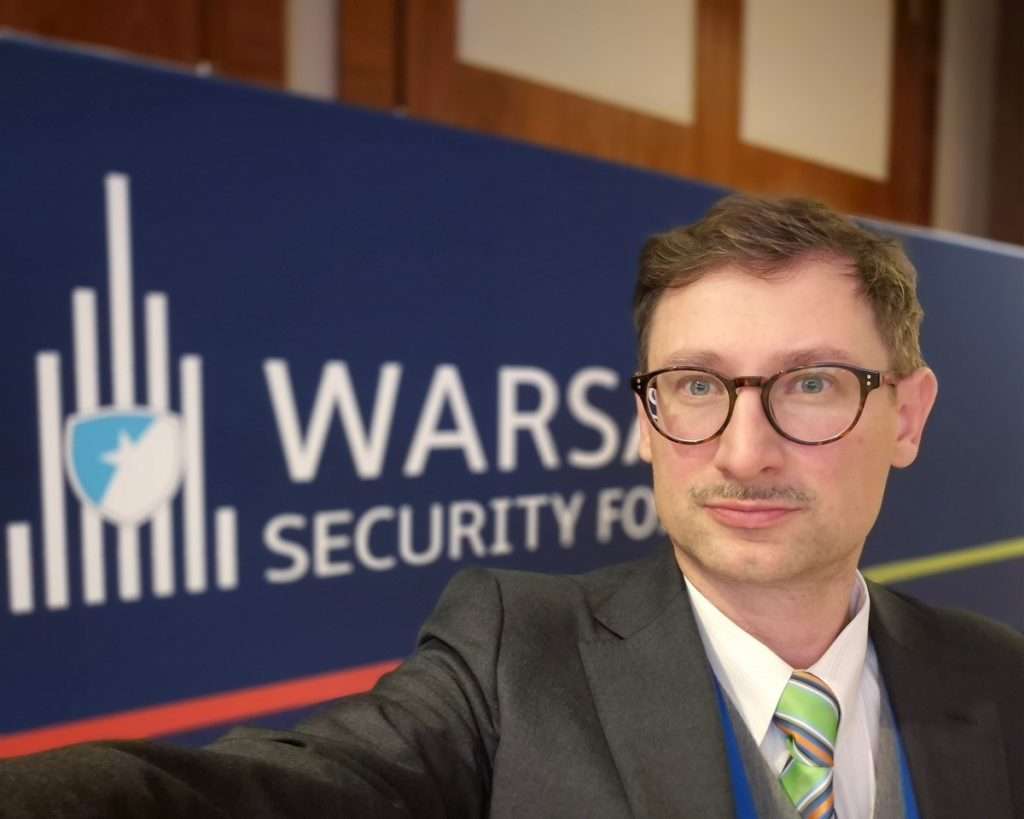
By Dariusz Dybka, Director, von Kietz
The Warsaw Security Forum (WSF) 2026 was a chance to rethink how Europe talks about security and how it delivers it. But first, the EU and NATO need to define what security as a common good means, and how far its geographical scope extends. With a long confrontation with Russia, hybrid threats, and growing pressure on critical infrastructure, spotting the risks is no longer enough. Europe has to turn assessments into political decisions, industrial capacity, and real operational readiness.
NATO’s Supreme Allied Commander Europe, General Alexus Grynkewich, outlined an approach to defeating Russia should it attack NATO: block, blunt, and break the forces conducting that aggression. The message is that deterrence works not just because NATO promises to respond, but because an aggressor comes to believe it cannot reach its goals. So what capabilities, investments, and institutions does Europe need to make that real?
Different forums, new formats
Davos and the WSF both gather influential people, but they do different jobs. Davos, the World Economic Forum’s annual meeting, helps manage global interdependence. It brings together leaders, executives, and investors, and is good at convening and mobilising capital. But it has no mandate to make binding decisions. It is a place for diagnosis and relationships. Its setting is global, so its concerns extend well beyond questions of what is made in Europe.
The WSF, held in an American hotel chain, sometimes feels as though it could be an event in Washington, DC. Yet its location matters. It sits close to real security challenges and to political and military decision-makers. It does not replace NATO or the EU, but it can build a shared understanding of threats, expose capability gaps, and form coalitions around concrete priorities. It is not yet a business fair, but could become one with time. Procurement bodies across NATO and the EU now seem to be among the hottest institutions.
The real difference is not how senior the participants are. It is the distance between discussion and delivery. Warsaw’s challenge is to show that it can help shorten that distance.
Why Warsaw matters
European security cannot be separated from economic resilience, energy, technology, and industrial competitiveness. Warsaw gives a platform to countries that have long seen Russia as an immediate threat, where security is a precondition for democracy, growth, and sovereignty. My personal favourite was the presence of Garry Kasparov. His message was stark: Russia will not understand an outcome other than victory or collapse.
The eastern flank is often treated as just the first line of defence. In fact, the Nordic, Baltic, and Central European states bring operational experience, regional knowledge, and a clear grasp of how military readiness and societal resilience connect. The task is to make that an asset for the whole EU.
Norway: linking the High North and the eastern flank
The presence of Prime Minister Jonas Gahr Støre, and Norway’s role as the Forum’s partner nation, show why cooperation must reach beyond the EU. Norway is outside the Union but is a key NATO ally and a major energy partner. Its role in the High North, the North Sea, energy infrastructure, and support for Ukraine ties northern security to Europe’s wider interests.
There was also something concrete alongside the discussions. Støre and Polish Prime Minister Donald Tusk signed a declaration on a strategic partnership, with a particular focus on security, defence, preparedness, resilience, and support for Ukraine. The two countries also share interests in Baltic Sea security and the protection of critical infrastructure. Another declaration, certainly. But one that gives a clearer direction to cooperation between the northern and eastern parts of Europe. The next question is what follows it.
Again, the link between military and energy operations is very tight. It is not only about Hormuz. Much closer to home, Europe’s energy security also depends on its northern neighbour and the infrastructure connecting it to the continent. Then there is the Arctic. Not a new topic as such, but one receiving renewed attention. Winter uniforms may well be the flavour of the day in the next few seasons.
From the eastern flank to European agency
Frontline countries can shorten the path from recognising a problem to responding. But that only works if combined with Europe’s industrial base, finance, and technology. A credible strategy needs more than higher defence budgets: production at scale, military mobility across borders, protected infrastructure, resilience to cyberattacks, and sustained support for Ukraine.
The final shape of EU funding is still to be determined through the next Multiannual Financial Framework, alongside national spending commitments. Yet, looking at the ambitions being discussed, the stream of money seems bottomless. As the Dutch defence minister put it at the Euronews Defence and Space Summit, money is not the issue; production capacity is.
I would add another question: what new technologies will be available to the civilian sector once this deluge of investment has passed? Will there be new communication tools, flying vehicles, or autonomous mobility that revolutionises the transport sector? The question is not only how much Europe spends, but what it learns to make, and what remains once the immediate urgency has passed.
Security as a European public good
Disruption to energy, attacks on digital networks, instability in Ukraine, and supply chain breaks hit the entire European economy. Frontline states bring urgency and experience; larger economies bring scale and capital; EU institutions can ease cross-border investment; partners such as Norway add military and energy cooperation; and Ukraine contributes innovation forged in war. These are complementary parts of one European system, even when national interests differ.
Seeing security as a public good also changes the investment debate. The benefits of resilient infrastructure, military mobility, cyber defence, and a competitive defence industry reach far beyond those who pay for them. That makes coordination, joint procurement, and European-level financing essential.
In the end, Europe’s security will depend less on how well it describes the threats and more on how effectively it turns its resources into research, production capacity, and operational readiness.
By Dariusz Dybka, Director, von Kietz
Dariuz is a law graduate of the University of Warsaw. He was a Lantos Fellow at the US House of Representatives and participated in a study group on Capitol Hill. A legal expert on the UNFCCC process, he served as an alternate member of the Facilitative Branch of the Kyoto Protocol Compliance Committee and as Climate Attaché during the Polish Presidency of the Council of the European Union. Between 2012 and 2016, he negotiated EU directives and regulations on climate change and air quality.
Before joining the private sector, he worked for a think tank, advised an electricity association, and served as a representative to the European power sector’s umbrella organisation. He has extensive experience in media communication and has served as Principal Advisor to Business and Science Poland in Brussels since 2024.