

On clean air, European mobility, and the peculiar business of registering the same car repeatedly. I have recently bought a used Euro 5 petrol car. It is a 2010 car, which means that it has already lived through several political cycles, survived a fair amount of French administration and, if all goes to plan, will soon be converted to run
Headlines: ENVI backs lower car and van CO₂ targets and zero-emission status for eligible-fuel vehicles Cycling groups criticise weaker company bike provisions in corporate fleet compromise Commission tourism strategy sets out aviation, car rental, and ticketing reforms VÆRIDION raises €30 million and secures selection for EU grant as electric aviation programmes advance EIB agreement opens way for financing Canadian critical
Headlines: UK Budget extends fuel-duty relief and supports public EV charging while reducing hydrogen grants US questions Airbus financing under EU aircraft subsidy truce FuelsEurope warns investment delays threaten 2030 synthetic aviation fuel supply ACEA warns truck weight compromise could undermine zero-emission vehicle uptake Commission considers digital enforcement and simpler road transport rules Inland shipping needs stronger business cases to
Headlines: France and Germany seek more flexibility for Europe’s automotive industry ENVI amendments put transport funding, aviation coverage and ETS2 costs in focus Commission says Port Services Regulation has brought limited change to existing practices EU foreign-investment screening rises as manufacturing remains the largest sector Geopolitical uncertainty prompts supply-chain changes, Beazley survey finds UK removes planning permission for cross-pavement EV
Headlines: ECSA calls for tripling proposed maritime ETS support to 330 million allowances SESAR urges continued investment in Europe’s air traffic management Transport MEPs back dedicated high-speed rail funding ahead of plenary vote Commission selects 46 strategic raw materials projects T&E says real-world PHEV emissions remain far above official figures Busworld opens exhibitor list for its 2027 Brussels show Study
Headlines: Ricci proposes 70% reinvestment requirement for aviation and maritime ETS revenues EU transport emissions rise 2% as rail freight declines Bloss seeks electrification-first ETS funding, reduced biofuel support, and carbon pricing for contrails Fuel associations seek binding renewable transport targets beyond 2030 Industry and NGOs oppose further delay to ETS2 implementation Commission rejects €26 million in Polish aid for
By Dariusz Dybka, Managing Partner at Von Kietz Strategies in Brussels, former SVP and Head of Sustainability at Edelman, Climate Attaché at the Polish Permanent Representation to the EU, and recently principal advisor at Business and Science Poland in Brussels. Two events in two weeks frame the same question. At the New Mobility Congress in Katowice, an exhibition floor sat alongside policy
Headlines: Von der Leyen calls for ‘true Transport Union’ as Commission seeks to double infrastructure funding Atlantic Corridor set to miss 2030 TEN-T completion target EU vehicle manufacturing employment fell 9% between 2019 and 2023, study finds Electric trucks already cheaper than diesel in six major EU markets, T&E finds EV depreciation gap narrows sharply after adjusting for prices and
Headlines: Commission targets 400,000 zero-emission trucks by 2030 under electrification plan EU SAF supply reaches 2.79% as imported feedstocks dominate ReFuelEU market EESC calls for transport rule simplification while warning against deregulation Global rail market grows as access for European suppliers continues to decline EU automotive research needs faster route from demonstration to industrial deployment, JRC finds Europe paying €203

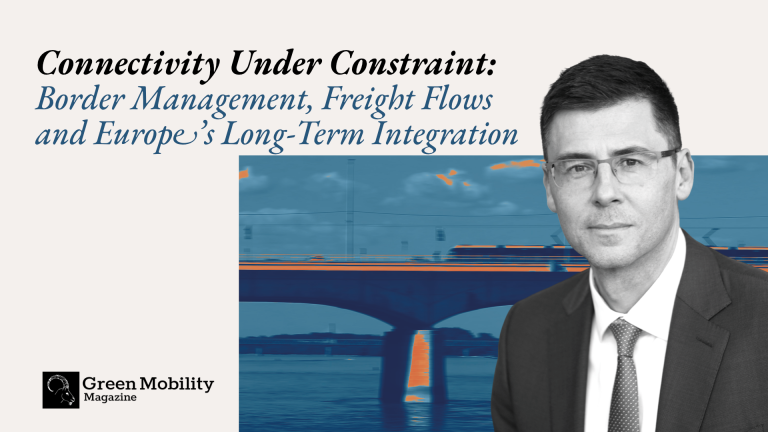
By Thomas Jeremie Hayden-Lefebvre & Swyn Griffith – Green Mobility Magazine An interview with Andor Deli, former Member of the European Parliament and Hungary’s national coordinator for the EU–Western Balkan Green Lanes Initiative. Andor Deli, former Member of the European Parliament and Hungary’s national coordinator for the EU–Western Balkan Green Lanes Initiative, discusses border efficiency, freight flows, and the role of transport policy in the EU’s enlargement process. You grew up in a region shaped by external borders and administrative constraints. How did those early experiences influence your understanding of mobility not only as a technical issue, but as a political and economic one? During my childhood, back in the 1980s, travel was almost always associated with queuing at border crossings. I vividly remember spending long hours sitting in a car under the blazing summer sun or in the freezing cold of winter, waiting to cross. Later, as a student,

As of January 2025, the maritime transport sector is significantly impacted by the FuelEU Maritime Regulation (Regulation (EU) 2023/1805) (“Regulation” or “FEUM”), adopted on September 13, 2023. This Regulation imposes stringent restrictions on greenhouse gas (GHG) emissions from large ships within its scope and constitutes a fundamental cornerstone of the European Union’s strategy to transition towards sustainable transportation and achieve full decarbonisation of the transport sector by 2050. The year 2025 will be pivotal for shipping companies, as they will be required to integrate these new regulatory requirements into their business operations. This will not only have economic repercussions but will also necessitate revisions to contractual relationships. Maritime operators must ensure that existing contracts reflect the Regulation’s new obligations and incorporate the mechanisms established by the EU to facilitate compliance. Before addressing the contractual implications, it is useful to provide a brief overview of the Regulation’s key provisions. The Legal
In the first half of 2025, key European industries face an inflection point, with the new political forces in the European Union attempting to shape the path ahead. The future of transport policy—laid out in the Green Industrial Deal and the Action Plan released following the Strategic Dialogue on the Future of the Automotive Industry—is at a crossroads. Policymakers must decide whether to embrace the opportunities of decarbonisation or double down on the energy sources of the past. As policy negotiations advance, investors and real economy companies will have the opportunity to influence key steps towards meeting Europe’s climate goals. As long-term institutional investors, asset owners hold an influential position in the financial system. Pension funds, insurance companies, and sovereign wealth funds can impact the behaviour of their asset managers, the companies in which they invest, and policymakers and regulators across a wide range of sectors. Over the past few
Submit an Op-ed to the Green Mobility Magazine


Europe’s exposure to hybrid threats reaches into the systems that preserve food, store blood products, transport passengers, and maintain communications. Over recent weeks, refrigeration cyberattacks have forced supermarkets to discard stock and threatened plasma stored by France’s blood service. Bomb threats have prompted aircraft diversions, military escorts, and security searches. Investigations into attacks on satellite communications infrastructure have led to
France’s preparations for a major European conflict depend on keeping civilian services functioning while deploying armed forces abroad and responding to disruption at home. Parliamentary testimony exposes the practical tension: the personnel, infrastructure, and suppliers needed for military mobilisation also sustain the economy on which that mobilisation depends. A National Assembly defence committee report brings together hearings conducted in May
By Dariusz Dybka, Director, von Kietz The Warsaw Security Forum (WSF) 2026 was a chance to rethink how Europe talks about security and how it delivers it. But first, the EU and NATO need to define what security as a common good means, and how far its geographical scope extends. With a long confrontation with Russia, hybrid threats, and growing
On Saturday, my family and I watched from our balcony as CRS riot police confronted protesters and, subsequently, rioters outside the government building opposite our flat. Our exposure was necessarily limited, but the distinction between those who had come to express their dissatisfaction and those who had come to cause violence was quite clear. The procession itself, the cortège, followed
Over the past two weeks, a series of security incidents has affected critical and strategic infrastructure across Europe. Rail disruption, drone incursions, incidents affecting airports and border infrastructure, fires and attempted attacks involving defence-industrial sites, and increasingly serious military encounters have all formed part of the European security picture. These events have different circumstances and, where established, different attributions. They
Contribute to Modern Sovereignty
Our Call for Submissions is open.
We are inviting policymakers, industry leaders, academics, and experts to contribute perspectives on the capabilities, infrastructure, and technologies underpinning European sovereignty.
Defence and security. Critical infrastructure and resilience. Technology and energy. Transport and supply chains. Strategic autonomy.
Subscribe to the monthly Green Mobility Magazine Newsletter to receive email briefings on sustainable transport developments.