GMPB — April 10th — EV Uptake Gap Widens as EP Flags China’s Industrial Overcapacity and IMO Debate Intensifies

Headlines: Parliament study highlights EV and battery exposure to Chinese overcapacity Study finds GHG pricing central to investable global shipping transition US trade chief questions WTO relevance after ministerial conference EU consumer survey finds affordability and practicality remain key barriers to EV uptake German diesel cost surge widens gap with electric trucks Commission opens applications for 40,000 DiscoverEU rail travel

GMPB — March 27th — Oil Shock Drives Demand Cuts as AFIR Review, EV Gap and Rail Investment Sharpen EU Transport Debate

Headlines: IEA urges immediate demand cuts as Hormuz disruption removes major oil flows Commission opens AFIR review, signals possible recalibration of targets and user requirements IRU urges EU transport ministers to act on fuel price surge and market distortions T&E says EU three years behind China on EV uptake, warns against weakening CO₂ standards Commission registers ECI proposing aviation fuel

GMPB — March 20th — Airlines Challenge SAF Trajectory as Rail and Connectivity Policies Advance

Headlines: A4E calls for SAF cost relief, signals shift on eSAF mandate as aviation strategy debate intensifies eFuel study questions EV rollout assumptions, points to continued role for liquid fuels FS maintenance investment in Paris signals renewed push for cross-Channel rail competition Commission study flags decarbonisation tensions in forthcoming revision of aviation State aid rules Commission reshapes State aid rules

GMPB — March 13th — US Tariff Probe Targets EU Manufacturing as Global Aviation and Shipping Climate Rules Face Strain

Headlines: US launches Section 301 investigations into global manufacturing overcapacity, including EU transport industries ReFuelEU Aviation debate highlights international tensions over aviation decarbonisation Geopolitical tensions raise questions over enforcement of global aviation climate scheme Oil and gas sector calls for ‘stop the clock’ on EU methane rules Transitional shipping fuels risk delaying ammonia shift without stronger policy signals, study says

GMPB — 6 March 2026 — EU Unveils Maritime and Ports Strategies as Shipping Faces IMO Net Zero Uncertainty

Headlines: European Commission sets out industrial maritime strategy with new alliance, procurement push and trade defence options European Commission sets out EU Ports Strategy centred on competitiveness, security and energy transition Shipping industry urges adoption of IMO net zero framework as uncertainty clouds decarbonisation pathway Commission proposes Industrial Accelerator Act with measures affecting automotive supply chains and low-carbon materials Study

GMPB — The 27th of February 2026 — €100 Billion CEF Demand, Corporate Fleet Rules, Maritime Fuel Lobbying and Cabotage Decision

Headlines: EU budget: Transport sector calls for €100 billion CEF in next MFF Cyprus Presidency sets out transport, energy and defence priorities to Parliament Clean Corporate Vehicles: T&E urges higher ZEV targets and exclusion of plug-in hybrids Mobility startups: EIT Urban Mobility leads European investment ranking as sector funding normalises EMSA study finds hull air lubrication technically viable but performance

DECARBON 2026 Concludes with Two Days of Strategic Debate and Practical Decarbonisation Insights

Hosted by Shell and held in partnership with Moeve, Fluor, Gasunie, The International Association of Oil & Gas Producers, Repsol, Spiecapag and Germany Trade and Invest, DECARBON 2026 centred on practical decision-making at the intersection of policy, technology and implementation across the oil and gas value chain in Vösendorf, Austria. On 9 February, the first day opened with an Executive

Green Mobility Policy Brief — 13 February 2026 — Industrial Competitiveness, Airport Capacity and Trade Defence

Headlines: Industry coalition urges European Council to adopt emergency competitiveness measures Commission lines up maritime, ports and energy files for late February and March EU court adviser backs Dublin airport passenger cap in slot dispute Commission says zero pollution progress mixed, flags transport noise and maritime spill risks Study finds sulphur cap cut shipping pollution by half in North and

GMPB — The 6th Of February 2026 — Leaked Maritime Strategy, Critical Raw Materials Tensions, ETS and Infrastructure

Headlines Leaked Commission draft reframes maritime policy around industry, security and ETS revenue use Leaked EU ports strategy expands security and energy role without new binding powers Dual fuel fleet doubles in a year as shipping investment accelerates UK brings London Northwestern and West Midlands rail services into public ownership under GBR reform EIB steps up Western Balkans rail and

Articles from the Annual Green Mobility Magazine

Green Mobility as Strategic Infrastructure for European Defence

By Mohsen Behzad Karimi, EU Correspondent & Analyst, Green Mobility Magazine. Defence capability is often measured in platforms and personnel. Far less attention is paid to the mobility and logistics infrastructure that allows force to move, endure, and regenerate. This analysis argues that sustainable mobility has become one of Europe’s most consequential defence enablers, directly translating strategic autonomy into operational readiness. European defence capability is usually assessed through force structure, procurement, and spending levels. Yet recent conflicts have reaffirmed an older strategic truth: logistics, energy access, and mobility infrastructure determine operational endurance. The war in Ukraine has exposed the fragility of fuel-dependent supply chains and the decisive value of resilient transport systems. Against this backdrop, sustainable mobility must be understood not as an environmental adjunct, but as strategic infrastructure at the heart of European defence planning. Mobility, energy, and geopolitical dependency Contemporary geopolitics is increasingly shaped by control overflows rather

Omnibus paquet automobile : une victoire symbolique, un cap toujours inchangé 

Anne-Sophie Frigout est députée française au Parlement européen, membre du groupe des Patriotes pour l’Europe. Engagée dans la défense des automobilistes et de l’industrie automobile française, elle a fait ses premières armes en 2022, comme députée à l’Assemblée nationale, où elle a notamment été la première à déposer une proposition de loi visant à abroger les Zones à Faible Émission — un dispositif imposé par Bruxelles, destiné à exclure des centres urbains, les catégories populaires n’ayant pas les moyens de changer de véhicule. Aujourd’hui, au sein de la commission Environnement, elle poursuit ce combat pour que l’Europe tourne la page d’une écologie exclusivement normative et repense en profondeur les fondements de sa stratégie industrielle automobile. Si le Green Deal a contribué à faire basculer l’Europe d’une terre d’industrie automobile à un simple marché, pris en étau entre la Chine et les États-Unis, sans pour autant répondre aux défis écologiques, la
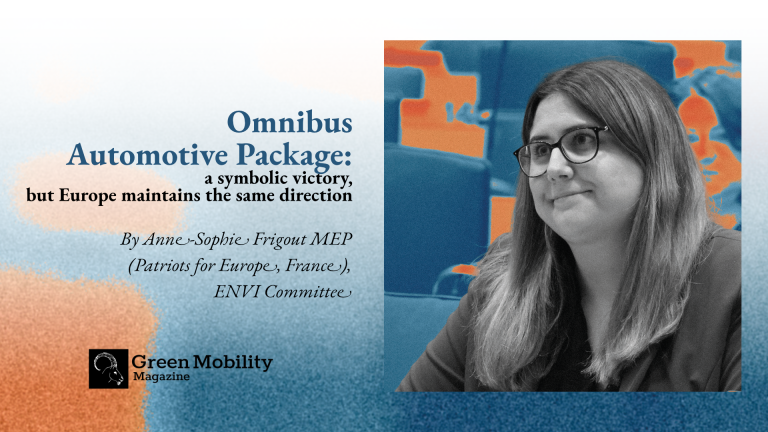
Omnibus Automotive Package: a Symbolic Victory, but Europe Maintains the Same Direction 

Anne-Sophie Frigout is a French Member of the European Parliament, affiliated with the Patriots for Europe group. Committed to defending motorists and the French automotive industry, she began her political career in 2022 as a deputy in the National Assembly, where she was notably the first to propose a bill aimed at repealing Low Emission Zones — a Brussels-imposed measure that would have excluded lower-income residents from city centres, as they could not afford to change their vehicles. Today, as a member of the Environment Committee, she continues this fight, advocating for Europe to move beyond a purely regulatory approach to environmental policy and to fundamentally rethink the foundations of its automotive industrial strategy. If the Green Deal has contributed to turning Europe from a land of automotive industry into a mere market, caught between China and the United States, without truly addressing environmental challenges, the new majority in the

Submit an Op-ed to the Green Mobility Magazine

At Green Mobility Magazine, we believe that diverse voices and innovative ideas are crucial in driving the transition towards sustainable transportation. Our op-ed section provides a platform for thought leaders, policymakers, researchers, and industry experts to share their insights and shape the discourse on green mobility.

European Infrastructure & Security Incidents: Weeks 41-46

Europe’s exposure to hybrid threats reaches into the systems that preserve food, store blood products, transport passengers, and maintain communications. Over recent weeks, refrigeration cyberattacks have forced supermarkets to discard stock and threatened plasma stored by France’s blood service. Bomb threats have prompted aircraft diversions, military escorts, and security searches. Investigations into attacks on satellite communications infrastructure have led to

France’s War Preparations Expose Competing Demands on the Civilian Economy

France’s preparations for a major European conflict depend on keeping civilian services functioning while deploying armed forces abroad and responding to disruption at home. Parliamentary testimony exposes the practical tension: the personnel, infrastructure, and suppliers needed for military mobilisation also sustain the economy on which that mobilisation depends. A National Assembly defence committee report brings together hearings conducted in May

Beyond the Security Forum: Warsaw is Not Davos. Europe After the Age of Declarations

By Dariusz Dybka, Director, von Kietz  The Warsaw Security Forum (WSF) 2026 was a chance to rethink how Europe talks about security and how it delivers it. But first, the EU and NATO need to define what security as a common good means, and how far its geographical scope extends. With a long confrontation with Russia, hybrid threats, and growing

Disorder, the Demand for Order, and Those Who Stand to Benefit

On Saturday, my family and I watched from our balcony as CRS riot police confronted protesters and, subsequently, rioters outside the government building opposite our flat. Our exposure was necessarily limited, but the distinction between those who had come to express their dissatisfaction and those who had come to cause violence was quite clear. The procession itself, the cortège, followed

Fourteen Days of European Infrastructure & Security Incidents – September 2026

Over the past two weeks, a series of security incidents has affected critical and strategic infrastructure across Europe. Rail disruption, drone incursions, incidents affecting airports and border infrastructure, fires and attempted attacks involving defence-industrial sites, and increasingly serious military encounters have all formed part of the European security picture. These events have different circumstances and, where established, different attributions. They

Contribute to Modern Sovereignty 

Our Call for Submissions is open.

We are inviting policymakers, industry leaders, academics, and experts to contribute perspectives on the capabilities, infrastructure, and technologies underpinning European sovereignty.

Defence and security. Critical infrastructure and resilience. Technology and energy. Transport and supply chains. Strategic autonomy.