GMPB — September 18th — Aviation Offsets Face Integrity Questions as Heathrow Expansion Tests UK Climate Rules

Headlines: EU study raises concerns over integrity of aviation offsets under CORSIA Business aviation accounts for a third of exempted EU aviation emissions, study finds EU maritime emissions reporting managed with expansion, but overlapping rules add work, study finds UK climate advisers say Heathrow expansion requires aviation emissions rules EU publishes harmonised EV battery durability standard UK sets out rail

GMPB — September 11th — Smart Charging Could Cut Grid Costs as Foreign Electric-Truck Competition Intensifies

Headlines: Smart charging could reduce Europe’s grid investment needs by €10.6 billion Chinese and US manufacturers could capture up to a quarter of European electric truck market by 2030 Real-world plug-in hybrid emissions reach six times official test results ICRT paper proposes airport-level emissions caps if aviation measures fall short Parliament committee backs stronger EU role in cross-border energy infrastructure

GMPB — September 4th — Maritime Industrial Alliance Takes Shape as Rail Service Bottlenecks Face Scrutiny

Headlines: Commission launches maritime alliance to strengthen European manufacturing Commission opens evaluation of EU airport noise rules UK opens review of zero-emission vehicle mandate as government tests lower 2030 targets Preliminary data put battery-electric car share at 26.3% across reporting EU markets EUI brief warns service-facility bottlenecks could constrain EU rail growth Commission endorses €4.8 billion Greek Social Climate Plan

World Maritime Forum 2027 Will Bring the Maritime Industry to Copenhagen on February 23-24

The two-day maritime conference is scheduled to take place at Copenhagen’s AC Bella Sky Convention Center on 23-24 February 2027. World Maritime Forum 2027 will return to Copenhagen for two days of industry dialogue at the AC Bella Sky Convention Center. Organised by IGGS Group, the gathering will unite shipowners, ship managers, shipbuilders, ports, authorities, maritime suppliers and service providers.

Energy, E-Fuels, And Policy: An Interview with Jutta Paulus MEP

As the European Union advances binding decarbonisation measures across transport, the role of e-fuels has become one of the most contested issues in EU energy and climate policy. Aviation is preparing for the gradual introduction of synthetic fuel obligations under ReFuelEU Aviation, while maritime transport faces a more fragmented transition under FuelEU Maritime, alongside difficult and unresolved negotiations at the

eFuels Ramp-up Potentials: The Way Forward to Create a New Industry.

By the Green Mobility Magazine in partnership with the eFuel Alliance. A new study by the eFuel Alliance, developed with Porsche Consulting, argues that the debate over e-fuels in Europe should shift from technological feasibility to industrial deployment. In an interview with the Green Mobility Magazine, CEO Ralf Diemer said the report assesses the global potential of e-fuels and their

Scaling Sustainability: Why Competitiveness and Circularity Must Move Together

Q: How would you assess the automotive supply industry’s progress on sustainability in recent years? Automotive suppliers are committed to achieving climate neutrality in their European operations (Scope 1 and 2) by 2040 and across the value chain (Scope 3) by 2050. This ambition is backed by concrete action. Between 2023-2024, the group of largest automotive suppliers have collectively reduced

GMPB – 3 July 2026 – Irish Presidency Sets Out Priorities as Half of Countries Invest Only 1% of GDP in Transport Infrastructure

Headlines: Irish Presidency prioritises transport connectivity, rail investment and energy resilience EU unveils €200 million South Caucasus connectivity package following Armenia-Azerbaijan peace agreement E-Mobility Europe says EV rollout could save EU €12 billion in oil imports annually by 2030 Half of countries invest less than 1% of GDP in transport infrastructure, ITF data show Commission challenges Dutch rail capacity rules

GMPB — June 26th — Renewable Fuel Vehicle Push Gains Momentum as French Court Expands Scope 3 Obligations

Headlines: Industry group seeks new renewable fuel vehicle category under EU car CO₂ rules French court orders TotalEnergies to include Scope 3 emissions in vigilance plan Study warns growing vehicle size could reduce urban parking capacity by up to 14% Shipping, aviation sectors seek ETS revenue earmarking for sustainable fuels UK launches review of SAF mandate amid concerns over future

Articles from the Annual Green Mobility Magazine

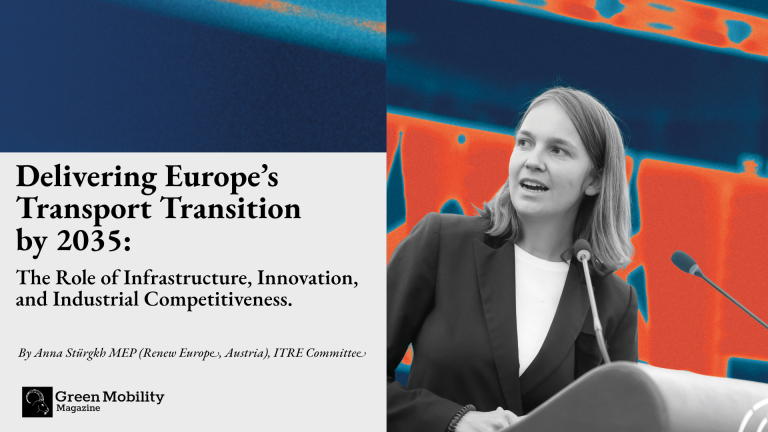
Delivering Europe’s Transport Transition by 2035: The Role of Infrastructure, Innovation, and Industrial Competitiveness

By Anna Stürgkh, MEP (Austria RENEW), ITRE Committee Europe stands at a crossroads. The next decade will determine whether we can turn our ambitious climate and mobility goals into a tangible reality. Without modern, resilient, and interconnected infrastructure, Europe’s green mobility revolution will stall before it starts. To date, our Union is facing major challenges that hinder the widespread adoption of electrified mobility. The electromobility’s upcoming challenges Limited grid capacityThe electrification of transport is not just about putting more electric vehicles on the road – it is about ensuring the grid can support them. Expanding the charging infrastructure puts additional strain on existing electricity grids, particularly the distribution grid at low and medium voltage levels, where electric cars are usually charged. This creates new peak loads, which occur when many vehicles charge simultaneously. Most of Europe’s electricity grids were not designed for this type of load but rather for a

From Raw Materials to Mobility: Aligning Supply, Demand and Industrial Policy in Europe 

By Dr Florian Anderhuber, Deputy Director General, Director Energy, Climate & Sustainability, Euromines. Mining sits at the foundation of Europe’s green mobility transition. The sector is not only supplying critical materials, but is itself undergoing rapid electrification, with more than 70% of metals mining already electrified. Thus, the transition is a dual one: how to green the value chain for the materials on which green mobility relies – a supply-side question –, while greening mobility in energy supply, infrastructure, while increasing its market share -, a demand side question. Both must go hand in hand: without a stable demand signal, the raw materials supply will face price volatility and chokepoints. Recent geopolitical shocks, supply chain disruptions and rising global demand have brought raw materials security to the centre of EU policymaking. Diversification and increased domestic production are now strategic priorities  Responsible minerals need a responsible vision  The European Union is
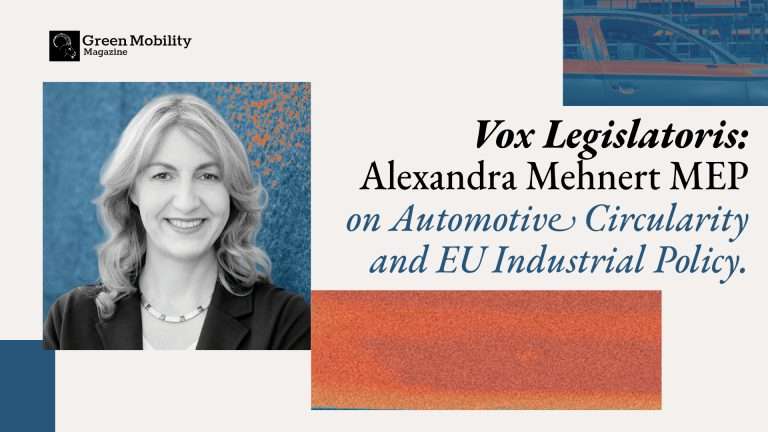
Vox Legislatoris: Alexandra Mehnert MEP on Automotive Circularity and EU Industrial Policy 

The European Union is developing a new framework for vehicle circularity and end-of-life management, consolidating rules on vehicle design, recyclability and end-of-life treatment into a single regulatory structure. The measures are intended to increase material recovery, reduce exposure to imported raw materials and support the use of recycled content in new vehicles, while avoiding additional administrative burdens for manufacturers. The initiative places the automotive sector at the centre of a wider recalibration of EU climate and industrial policy. Circularity requirements are no longer framed solely as environmental instruments, but as tools to address supply chain vulnerability, cost pressures and strategic dependence in a globally exposed industry. For legislators, the challenge lies in delivering environmental gains without undermining investment certainty or industrial competitiveness. Alexandra Mehnert, a German Member of the European Parliament from Saxony-Anhalt and a member of the Transport and Tourism Committee, has focused on how these objectives translate into

Submit an Op-ed to the Green Mobility Magazine

At Green Mobility Magazine, we believe that diverse voices and innovative ideas are crucial in driving the transition towards sustainable transportation. Our op-ed section provides a platform for thought leaders, policymakers, researchers, and industry experts to share their insights and shape the discourse on green mobility.

European Infrastructure & Security Incidents: Weeks 41-46

Europe’s exposure to hybrid threats reaches into the systems that preserve food, store blood products, transport passengers, and maintain communications. Over recent weeks, refrigeration cyberattacks have forced supermarkets to discard stock and threatened plasma stored by France’s blood service. Bomb threats have prompted aircraft diversions, military escorts, and security searches. Investigations into attacks on satellite communications infrastructure have led to

France’s War Preparations Expose Competing Demands on the Civilian Economy

France’s preparations for a major European conflict depend on keeping civilian services functioning while deploying armed forces abroad and responding to disruption at home. Parliamentary testimony exposes the practical tension: the personnel, infrastructure, and suppliers needed for military mobilisation also sustain the economy on which that mobilisation depends. A National Assembly defence committee report brings together hearings conducted in May

Beyond the Security Forum: Warsaw is Not Davos. Europe After the Age of Declarations

By Dariusz Dybka, Director, von Kietz  The Warsaw Security Forum (WSF) 2026 was a chance to rethink how Europe talks about security and how it delivers it. But first, the EU and NATO need to define what security as a common good means, and how far its geographical scope extends. With a long confrontation with Russia, hybrid threats, and growing

Disorder, the Demand for Order, and Those Who Stand to Benefit

On Saturday, my family and I watched from our balcony as CRS riot police confronted protesters and, subsequently, rioters outside the government building opposite our flat. Our exposure was necessarily limited, but the distinction between those who had come to express their dissatisfaction and those who had come to cause violence was quite clear. The procession itself, the cortège, followed

Fourteen Days of European Infrastructure & Security Incidents – September 2026

Over the past two weeks, a series of security incidents has affected critical and strategic infrastructure across Europe. Rail disruption, drone incursions, incidents affecting airports and border infrastructure, fires and attempted attacks involving defence-industrial sites, and increasingly serious military encounters have all formed part of the European security picture. These events have different circumstances and, where established, different attributions. They

Contribute to Modern Sovereignty 

Our Call for Submissions is open.

We are inviting policymakers, industry leaders, academics, and experts to contribute perspectives on the capabilities, infrastructure, and technologies underpinning European sovereignty.

Defence and security. Critical infrastructure and resilience. Technology and energy. Transport and supply chains. Strategic autonomy.