

Headlines: Parliament study highlights EV and battery exposure to Chinese overcapacity Study finds GHG pricing central to investable global shipping transition US trade chief questions WTO relevance after ministerial conference EU consumer survey finds affordability and practicality remain key barriers to EV uptake German diesel cost surge widens gap with electric trucks Commission opens applications for 40,000 DiscoverEU rail travel
Headlines: IEA urges immediate demand cuts as Hormuz disruption removes major oil flows Commission opens AFIR review, signals possible recalibration of targets and user requirements IRU urges EU transport ministers to act on fuel price surge and market distortions T&E says EU three years behind China on EV uptake, warns against weakening CO₂ standards Commission registers ECI proposing aviation fuel
Headlines: A4E calls for SAF cost relief, signals shift on eSAF mandate as aviation strategy debate intensifies eFuel study questions EV rollout assumptions, points to continued role for liquid fuels FS maintenance investment in Paris signals renewed push for cross-Channel rail competition Commission study flags decarbonisation tensions in forthcoming revision of aviation State aid rules Commission reshapes State aid rules
Headlines: US launches Section 301 investigations into global manufacturing overcapacity, including EU transport industries ReFuelEU Aviation debate highlights international tensions over aviation decarbonisation Geopolitical tensions raise questions over enforcement of global aviation climate scheme Oil and gas sector calls for ‘stop the clock’ on EU methane rules Transitional shipping fuels risk delaying ammonia shift without stronger policy signals, study says
Headlines: European Commission sets out industrial maritime strategy with new alliance, procurement push and trade defence options European Commission sets out EU Ports Strategy centred on competitiveness, security and energy transition Shipping industry urges adoption of IMO net zero framework as uncertainty clouds decarbonisation pathway Commission proposes Industrial Accelerator Act with measures affecting automotive supply chains and low-carbon materials Study
Headlines: EU budget: Transport sector calls for €100 billion CEF in next MFF Cyprus Presidency sets out transport, energy and defence priorities to Parliament Clean Corporate Vehicles: T&E urges higher ZEV targets and exclusion of plug-in hybrids Mobility startups: EIT Urban Mobility leads European investment ranking as sector funding normalises EMSA study finds hull air lubrication technically viable but performance
Hosted by Shell and held in partnership with Moeve, Fluor, Gasunie, The International Association of Oil & Gas Producers, Repsol, Spiecapag and Germany Trade and Invest, DECARBON 2026 centred on practical decision-making at the intersection of policy, technology and implementation across the oil and gas value chain in Vösendorf, Austria. On 9 February, the first day opened with an Executive
Headlines: Industry coalition urges European Council to adopt emergency competitiveness measures Commission lines up maritime, ports and energy files for late February and March EU court adviser backs Dublin airport passenger cap in slot dispute Commission says zero pollution progress mixed, flags transport noise and maritime spill risks Study finds sulphur cap cut shipping pollution by half in North and
Headlines Leaked Commission draft reframes maritime policy around industry, security and ETS revenue use Leaked EU ports strategy expands security and energy role without new binding powers Dual fuel fleet doubles in a year as shipping investment accelerates UK brings London Northwestern and West Midlands rail services into public ownership under GBR reform EIB steps up Western Balkans rail and

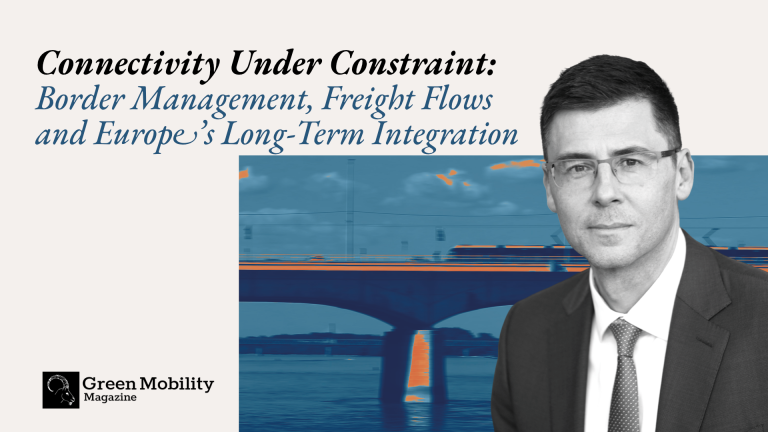
By Thomas Jeremie Hayden-Lefebvre & Swyn Griffith – Green Mobility Magazine An interview with Andor Deli, former Member of the European Parliament and Hungary’s national coordinator for the EU–Western Balkan Green Lanes Initiative. Andor Deli, former Member of the European Parliament and Hungary’s national coordinator for the EU–Western Balkan Green Lanes Initiative, discusses border efficiency, freight flows, and the role of transport policy in the EU’s enlargement process. You grew up in a region shaped by external borders and administrative constraints. How did those early experiences influence your understanding of mobility not only as a technical issue, but as a political and economic one? During my childhood, back in the 1980s, travel was almost always associated with queuing at border crossings. I vividly remember spending long hours sitting in a car under the blazing summer sun or in the freezing cold of winter, waiting to cross. Later, as a student,

As of January 2025, the maritime transport sector is significantly impacted by the FuelEU Maritime Regulation (Regulation (EU) 2023/1805) (“Regulation” or “FEUM”), adopted on September 13, 2023. This Regulation imposes stringent restrictions on greenhouse gas (GHG) emissions from large ships within its scope and constitutes a fundamental cornerstone of the European Union’s strategy to transition towards sustainable transportation and achieve full decarbonisation of the transport sector by 2050. The year 2025 will be pivotal for shipping companies, as they will be required to integrate these new regulatory requirements into their business operations. This will not only have economic repercussions but will also necessitate revisions to contractual relationships. Maritime operators must ensure that existing contracts reflect the Regulation’s new obligations and incorporate the mechanisms established by the EU to facilitate compliance. Before addressing the contractual implications, it is useful to provide a brief overview of the Regulation’s key provisions. The Legal
In the first half of 2025, key European industries face an inflection point, with the new political forces in the European Union attempting to shape the path ahead. The future of transport policy—laid out in the Green Industrial Deal and the Action Plan released following the Strategic Dialogue on the Future of the Automotive Industry—is at a crossroads. Policymakers must decide whether to embrace the opportunities of decarbonisation or double down on the energy sources of the past. As policy negotiations advance, investors and real economy companies will have the opportunity to influence key steps towards meeting Europe’s climate goals. As long-term institutional investors, asset owners hold an influential position in the financial system. Pension funds, insurance companies, and sovereign wealth funds can impact the behaviour of their asset managers, the companies in which they invest, and policymakers and regulators across a wide range of sectors. Over the past few
Submit an Op-ed to the Green Mobility Magazine


Europe’s exposure to hybrid threats reaches into the systems that preserve food, store blood products, transport passengers, and maintain communications. Over recent weeks, refrigeration cyberattacks have forced supermarkets to discard stock and threatened plasma stored by France’s blood service. Bomb threats have prompted aircraft diversions, military escorts, and security searches. Investigations into attacks on satellite communications infrastructure have led to
France’s preparations for a major European conflict depend on keeping civilian services functioning while deploying armed forces abroad and responding to disruption at home. Parliamentary testimony exposes the practical tension: the personnel, infrastructure, and suppliers needed for military mobilisation also sustain the economy on which that mobilisation depends. A National Assembly defence committee report brings together hearings conducted in May
By Dariusz Dybka, Director, von Kietz The Warsaw Security Forum (WSF) 2026 was a chance to rethink how Europe talks about security and how it delivers it. But first, the EU and NATO need to define what security as a common good means, and how far its geographical scope extends. With a long confrontation with Russia, hybrid threats, and growing
On Saturday, my family and I watched from our balcony as CRS riot police confronted protesters and, subsequently, rioters outside the government building opposite our flat. Our exposure was necessarily limited, but the distinction between those who had come to express their dissatisfaction and those who had come to cause violence was quite clear. The procession itself, the cortège, followed
Over the past two weeks, a series of security incidents has affected critical and strategic infrastructure across Europe. Rail disruption, drone incursions, incidents affecting airports and border infrastructure, fires and attempted attacks involving defence-industrial sites, and increasingly serious military encounters have all formed part of the European security picture. These events have different circumstances and, where established, different attributions. They
Contribute to Modern Sovereignty
Our Call for Submissions is open.
We are inviting policymakers, industry leaders, academics, and experts to contribute perspectives on the capabilities, infrastructure, and technologies underpinning European sovereignty.
Defence and security. Critical infrastructure and resilience. Technology and energy. Transport and supply chains. Strategic autonomy.
Subscribe to the monthly Green Mobility Magazine Newsletter to receive email briefings on sustainable transport developments.